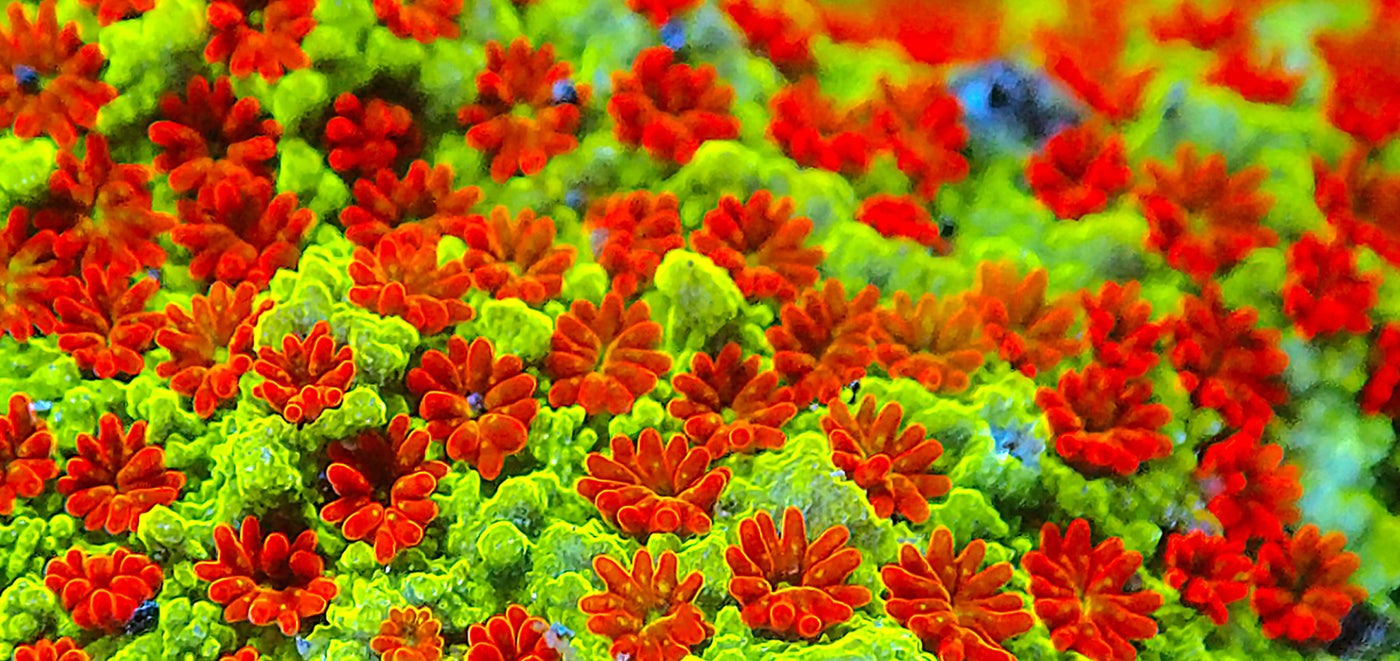
Toxic Green Goniastrea Fragment
Toxic Green Goniastrea Fragment is backordered and will ship once an order is placed. Contact us for delivery timeframes.

Delivery and Shipping
Delivery and Shipping
We offer Courier Services, Same Day Airfreight & Store Collection to suit a range of customers.
Questions? Get in touch!
Customer Reviews
EMA's Promise.
Qualified, Honest Advice Using Techniques & Protocols that we use ourselves.
Description
Description
Goniastrea corals are a familiar sight in reef aquariums, known for their distinctive brain-like appearance and hardy nature. As a classic large-polyp stony (LPS) coral, Goniastrea offers a mounding growth form that slowly encrusts over the rockwork. This particular variety presents with a consistent green colouration across its polyps, a common and well-loved colour morph in the hobby.
The surface of a Goniastrea colony is made of many individual polyps, or corallites, each with its own mouth. These polyps are fused together into a solid mass, creating meandering valleys that give the coral its characteristic maze-like pattern. During the day, polyps may remain mostly retracted, showing the skeletal structure, while at night or during feeding, short tentacles may extend, giving the surface a slightly fuzzy appearance.
For care in a home reef, Goniastrea is relatively straightforward. It prefers moderate light levels, with a PAR range of about 75-150 being a good target. It should be placed in an area of low to moderate water flow, enough to keep the surface clean without blasting the tissue. Direct placement on the sand bed or on lower rockwork is ideal. While photosynthetic, it benefits from occasional spot feeding with LPS-specific foods. It’s a peaceful coral but should still be given a few centimetres of space from its neighbours to allow for growth. Water parameters should be stable, with calcium at 420-440 ppm, alkalinity between 8-9 dKH, and magnesium around 1300-1400 ppm.
Goniastrea makes an excellent addition to a mixed reef, coexisting well with other peaceful inhabitants. Its slow, predictable growth means it won't overtake the tank, and its encrusting habit adds texture and stability to the aquascape over time. It's a reliable coral for aquarists who have mastered the basics of water chemistry and are looking to add a classic LPS piece to their system.
This is not a WYSIWYG listing; you'll receive a specimen of the same species with similar size and colouration to the one pictured, hand-picked for health and colour.
Our Quarantine Procedures
Our Quarantine Procedures
We take livestock seriously. That's why we don't sell anything we wouldn't be comfortable putting in our own tank.
As we are direct from source, we import and sell direct to the public. This means you can buy with confidence knowing EMA prides itself on excellent handling and conditioning protocols.
Fish
All our fish held in a quarantine system for a minimum of 3 weeks. During this time, regular water changes are performed, and twice daily (or sometimes more) feedings are performed.
Copper is dosed and checked twice a day for ich and velvet.
During this treatment fish are given formalin baths for brooklynella and a minimum of 3 praziquantel doses is performed for flukes.
Coral
Our coral is quarantined for a minimum of 3 weeks, just like fish. During this time, regular water changes are performed, water testing done, and once a month a Fauna Marin ICP Total is performed.
Corals are inspected for pests/general health and are provided with a pest dip once a week for at least 3 weeks.
If we see signs of pests, the quarantine period is extended and/or additional dips are performed
If coral is bleached/unhealthy, it will remain in quarantine until healthy enough to sell.
Payment & Security
We offer a number of different payment methods, including Credit Card, Afterpay, Q Card, Pay at Collection, Bank Transfer and POLi.
Credit card payments are processed securely using the highest possible security protocols.